
CV vs Resume
Updated by Khokhar Sab
A CV and a resume are both short histories of your work and education, written to win an interview. Which word you need depends on the country and the kind of job. In the United States a resume is the short document for industry jobs and a CV is the long record for academic work, while in the UK a CV is the document for any job. Make either one with our free CV Template or Resume Templates.
What is the difference between a CV and a resume?
The difference is mostly country and purpose. A US resume is a one or two page summary tailored to a single job, while a CV, short for curriculum vitae, is a fuller record of a career. In the UK, CV is simply the name of the job application document, and it covers what Americans call a resume.
In practice the two words cover three different documents:
- The US resume is a brief, targeted summary for industry jobs. MIT's career office says the word "resume" is used in the United States for industry and other non-academic positions.
- The US academic CV is a comprehensive scholarly record. MIT says it values completeness over brevity and describes teaching and research in detail.
- The UK-style CV is the standard application document, usually two pages. Wikipedia's résumé article says a CV is used for similar purposes in countries across Europe, the Middle East, Africa and Asia, though it adds that international CVs vary by country.
Ask which document this employer expects. The job advert, the country and the field answer it, and the sections below cover each case.
What is a CV?
CV stands for curriculum vitae, a Latin phrase meaning 'course of life'. It is a document that lists your education, work history and skills, and in some fields your research, publications, grants and teaching. In the UK it is the normal job application document, and in US universities it is the complete record of an academic career.
That is also the answer to "CV meaning" and "what does CV stand for". Prospects gives the Latin translation, and the National Careers Service lists the sections a UK CV should hold: contact details, an introduction, education history, work history and references. Our CV Template page has three designs that start with those sections, plus an academic design with publications, grants and teaching.
What is a resume?
A resume is a short summary of your work history, skills and education, tailored to one job. MIT's career office advises sticking to one page unless you have extensive experience or an advanced degree. The word comes from the French résumer, meaning 'to summarize', and in the United States it is the standard document for industry jobs.
MIT also tells applicants that a resume does not need full sentences, should avoid the first person, and should not include age, religion, health or marital status. Browse the Resume Templates to see seven designs, or open the Resume Builder to write one from scratch.
Is a CV the same as a resume?
Sometimes. Prospects says that in the USA and Canada a CV is known as a resume, and in the UK a CV is the document employers ask for, so the two words can mean the same thing. In US academia they differ: MIT calls a CV a comprehensive scholarly record, while a resume stays brief and targeted.
MIT adds one rule for job seekers abroad: in some international settings the term CV is used for all opportunities, but you should tailor the document to the position type. When an advert says "send your CV", follow its word and match the expected length for that country and field. The next two sections give the lengths and the situations.
When should I use a CV instead of a resume?
Use a CV when the advert asks for one, when you apply in the UK, or when the job is academic. MIT lists the US cases: teaching or research positions, fellowships, further academic training, grants, contract funding proposals, tenure, promotion to professor and membership in a professional society. For US industry jobs, send a resume.
- Applying for an industry job in the US: use a resume. Start from a design on the resume template page.
- Applying in the UK: use a CV of two A4 pages. The Classic CV and Modern CV templates open on A4 paper.
- Applying for a faculty, research or grant position: use an academic CV. The Academic CV template opens on US Letter paper with a date column.
- Applying abroad: check the employer's country page or ask the recruiter which length and sections they expect.
Whichever you send, pair it with a matching cover letter, and save both as PDFs. Our guide How to Prepare PDFs for a Job Application covers file names and size limits.
How long should a CV or a resume be?
MIT says a US industry resume runs 1 to 2 pages, with two for PhDs and people with more experience. Prospects quotes a University of Chester recommendation of no more than two A4 pages for a UK CV. A US academic CV is longer: MIT gives 2 to 4 pages early in a career and 4 to 7 later.
| Document | Typical length | Source |
|---|---|---|
| US industry resume | 1 page; 2 for PhDs or more experience | MIT |
| UK CV | No longer than 2 A4 pages | Prospects, quoting the University of Chester |
| US academic CV, younger professional | 2 to 4 pages | MIT |
| US academic CV, more experience | 4 to 7 pages | MIT |
Prospects adds that students seeking part-time jobs can send something shorter. The page count is a ceiling, and a CV that ends early is fine. The builder shows your page count as you type, and the Resume Builder has a Fit to one page button for resumes.
What does each one include?
Both list contact details, work history, education and skills. The National Careers Service says a UK CV adds an introduction and references, and MIT lists publications, grants, teaching and presentations among the common headings of a US academic CV. A resume keeps to the sections that the job needs and leaves the rest off.
| Feature | US resume | UK-style CV | US academic CV |
|---|---|---|---|
| Main aim | Brevity and relevance to one job | A clear picture of you for any job | A comprehensive scholarly record |
| Opening | Contact details | Short introduction or personal profile | Name and contact information, then education |
| Core sections | Experience, education, skills | Education history, work history, references | Education, research and teaching experience |
| Extras | Projects, certifications | Interests, if relevant | Publications, grants, fellowships, awards, presentations |
| References | Keep on a separate sheet; MIT says they are assumed available | Listed or "available on request" | Set by the application |
| Paper in our templates | US Letter | A4 | US Letter |
The National Careers Service says a UK CV should include contact details, an introduction, education history, work history and references, and it advises against listing your age, date of birth, marital status or nationality. MIT says a US resume should not include references unless asked, since employers assume they are available on request.
How do our sample CVs and resumes compare?
We measured the example documents that ship with our templates. The 6 US resume samples average 6 sections and 264 words, and 5 of them fit on one page. The UK-style CV samples have 7 sections, and the Academic CV sample has 11.
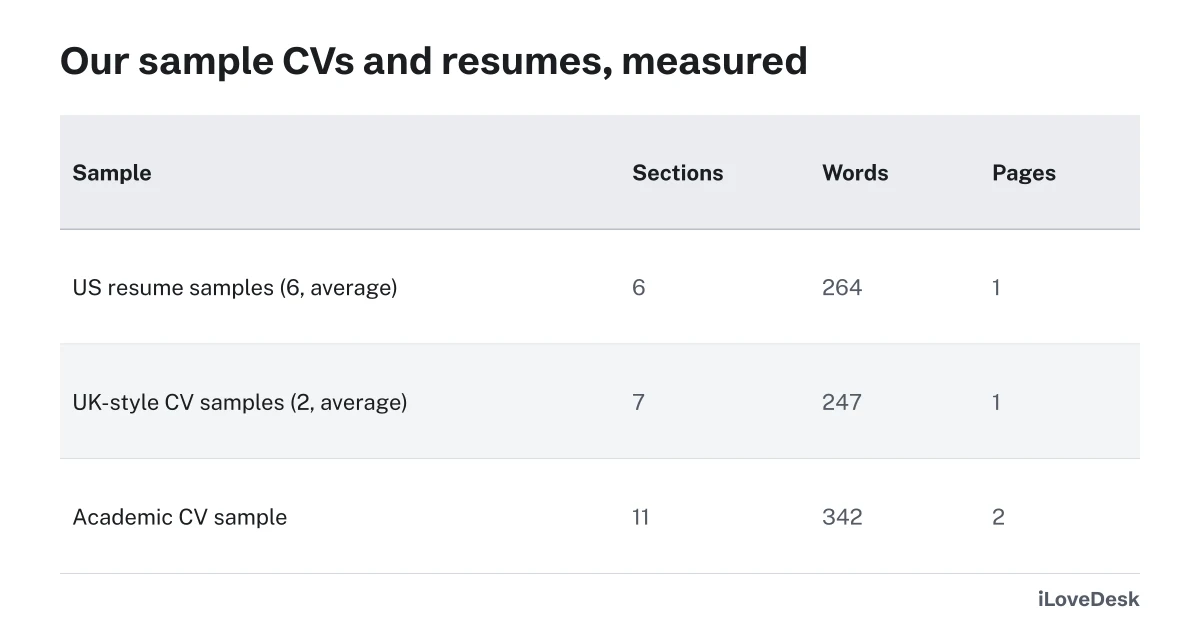
| Sample | Paper | Sections | Words | Pages |
|---|---|---|---|---|
| US resumes (6 designs) | US Letter | 5 to 6 | 227 to 313 | 5 of 6 on 1, the rest on 2 |
| Classic CV | A4 | 7 | 285 | 1 |
| Modern CV | A4 | 7 | 208 | 1 |
| Academic CV | US Letter | 11 | 342 | 2 |
The CV samples carry more sections than the resumes: 7 for the Classic CV, which adds Interests and References, and 11 for the Academic CV, which adds appointments, publications, grants, teaching, presentations, service and awards. The resume samples keep to 5 or 6. The academic sample lists 4 publications and uses 2 bullet lines under its jobs, because an academic CV spends its space on the scholarly record rather than on job duties. The two UK-style samples each fit on one A4 page, so a longer work history would fill the two pages that Prospects quotes.
These are made-up people with short histories, so the numbers show structure rather than a norm. A researcher with 40 papers would push an academic CV toward the 4 to 7 pages that MIT describes. You can open every sample as a PDF from the CV Template and Resume Templates pages.
Should a CV or resume have a photo?
Leave the photo off a US or UK application. MIT says photos are generally not preferred on US resumes, and Prospects says you do not need a photograph unless you are applying for acting or modeling work. Wikipedia notes that some countries in the Middle East, Africa and Asia expect a photograph and personal details, so check local practice.
Personal details follow the same split. The National Careers Service tells UK applicants to leave out age, date of birth, marital status and nationality, and MIT tells US applicants to leave out age, religion, health and marital status. Wikipedia's résumé article says that some countries in the Middle East and Africa and parts of Asia require items such as a photograph, gender, marital status and children, while the UK, the US and some European countries do not accept them. If you apply to such an employer, follow the format in their instructions.
The Modern CV template on our CV Template page has an optional photo beside the name. The photo stays in your browser and is never uploaded.
How do I turn a resume into a CV, or a CV into a resume?
To turn a resume into a CV, keep your work history and education, then add what the reader expects: a personal profile and references line for the UK, or publications, grants and teaching for academia. To turn a CV into a resume, cut it to one or two pages, keep only what fits the job, and drop the extras.
- Resume to UK CV: open the CV Template, pick Classic CV or Modern CV and press Fill in. The builder opens with CV section titles ready, and you paste in your jobs and education.
- Resume to academic CV: pick the Academic CV and add publications, grants, teaching and presentations. Length is not a concern here, since MIT puts completeness ahead of brevity.
- CV to resume: open the Resume Templates, choose a design and paste only the experience that matches the job you want. Remove interests, the references line and any photo.
- Check the page count beside the Download PDF button. In the Resume Builder, Fit to one page tries a smaller type size and margins.
- Write a new cover letter for each application, then download the PDF.
All three pages share one builder, and your draft stays in your browser. Keeping one master file with every job, grant and paper, and cutting from it for each application, is faster than rewriting from scratch.
What does biodata mean?
Biodata is short for biographical data. Wikipedia says that in India, Pakistan, Afghanistan, Bangladesh and Nepal it is essentially a resume or CV, used for jobs, grants and marriage. It generally adds personal details such as religion and nationality, and may include physical attributes. UK and US advice leaves such details off.
If an employer asks for a biodata, ask whether they want a form or a document. The same facts usually fit a CV: contact details, education, work history and skills. For a job in the UK or the US, drop the personal details listed above and follow the National Careers Service or MIT format instead.
Ready to write? Start from a CV template for the UK and academic jobs, or a resume template for US industry jobs.
Tools in this guide
More guides
Sources and further reading
- MIT Career Advising and Professional Development: Curricula vitae (CVs): US uses of a CV, CV vs resume table, academic CV length and headings
- MIT Career Advising and Professional Development: Resumes: resume length, photos, personal information, references
- Prospects: How to write a CV: CV meaning, USA and Canada naming, two A4 pages, photographs
- National Careers Service: How to write a CV: UK CV sections and what to leave out
- Wikipedia: Résumé: origin of the word, international CVs and personal data by region
- Wikipedia: Biodata: the South Asian use of the word