
How to Write an Obituary
Updated by Khokhar Sab
If you are writing this because someone has died, we are sorry for your loss. You do not need to write it all at once or write it perfectly. An obituary is a short set of facts in a fixed order, and a second person can check it for you. This guide covers the steps, the length, how to submit it and what to keep private. To have the text written from your facts, use the free Obituary Template. To read finished samples first, open the Obituary Examples.
How do you write an obituary?
Gather the facts first, then write them in a set order: the name, age and date of death; a short life story; the family who survive and who died earlier; and the service details. Keep the wording plain, ask a relative to check every name and date, and then send it to the newspaper or funeral home.
- Gather the facts from the list in the next section, and ask a relative to confirm each spelling and date.
- Choose a length: a short notice of about 60 words, a standard obituary of about 180, or a life story of about 390.
- Open with the name, age, hometown and date of death, in one sentence.
- Add the life story: where the person was born, school, marriage, work, faith or groups, and what the person loved.
- Name the family: those who died earlier, then those who survive.
- Give the service date, time and place and, if the family wishes, a charity for donations.
- Read it aloud, ask a second person to check every name and number, then submit it.
Our Obituary Template writes steps 3 to 6 from the facts you type, in four tones, and shows the word count as you go. Your draft stays in your browser.
If the story is hard to write today, write the facts now and add the paragraph about the person later, or ask a sibling or friend to write it. A short notice is a complete obituary.
What facts should I gather before writing an obituary?
Collect the full name and any nickname, the dates of birth and death, hometown, parents, spouse, school, work, military service, faith or club memberships, and interests. List the names and relationships of the family who died earlier and who survive. Ask the funeral home for the service date, time and place.
| Group | Facts to collect |
|---|---|
| The person | Full name, nickname, age, hometown, date of death, and where the person died if the family wishes to say |
| Early life | Birthplace, parents' names, school, marriage and the year |
| Working life | Jobs and how long, military branch and years, faith community, clubs, volunteer work |
| Character | Hobbies, habits, favorite places, one short story the family tells |
| Family | Who died earlier, then spouse, children, grandchildren, siblings, with spellings |
| Service | Kind of service, date, time, place, whether guests are welcome, a charity or a no-flowers request |
Our short sample notices use only the person, the family and the service rows, so a family short of time can start there and add later. The Obituary Template has a field for each row, and any fact you leave blank is left out of the draft with no gap.
How do you start an obituary?
Start with one sentence that gives the name, age, hometown and date of death. Here is the opening of one of our made-up samples: Margaret Ann Sample of Riverton died peacefully on February 14, 2026, at home. Margaret was 87. A reader who stops after that line already has the central facts.
The opening changes a little with the tone the family prefers. These three come from the template's writer, using made-up people:
- Warm: "Margaret Ann Sample of Riverton died peacefully on February 14, 2026, at home."
- Traditional: "Robert James Example, 84, of Pinecrest, passed away surrounded by his family on March 30, 2026, at the Pinecrest Care Center."
- Brief death notice: "SAMPLE, Ruth Evelyn, 92, of Riverton, died peacefully February 3, 2026, at home."
Choose the verb the family would use. "Died" is plain and "passed away" is softer. The family decides whether to say how the person died, and the template has no cause-of-death field, only a choice of wording such as peacefully or after a long illness.
What should an obituary include, and in what order?
Include the name, age, hometown and date of death, then birth and parents, school, marriage and work, groups and interests, family who died earlier and who survive, the service and any donation request. In our 23 samples, the date of death, hometown, surviving family and service details appear in every one.
| Fact | Samples with it | Share |
|---|---|---|
| Date of death and age | 23 of 23 | 100% |
| Hometown or residence | 23 of 23 | 100% |
| How the death is worded (peacefully, after illness) | 22 of 23 | 96% |
| Place of birth | 18 of 23 | 78% |
| Parents | 14 of 23 | 61% |
| Education | 17 of 23 | 74% |
| Marriage | 13 of 23 | 57% |
| Work | 18 of 23 | 78% |
| Military service | 4 of 23 | 17% |
| Faith community, clubs or groups | 11 of 23 | 48% |
| Interests and character | 18 of 23 | 78% |
| Family who died earlier | 19 of 23 | 83% |
| Surviving family | 23 of 23 | 100% |
| Service or gathering | 23 of 23 | 100% |
| Service date, time and place | 22 of 23 | 96% |
| Donations or flowers request | 19 of 23 | 83% |
The 5 short notices hold the opening, the family and the service, with a donation line in 2 of them. The longer samples add the life story, which is why work, interests and place of birth each appear in 18 of the 23 (every sample except the short notices). Military service appears in only 4 because only 4 of our made-up people served. Add a fact when it is true of the person.
The Obituary Template follows this order, and each page on Obituary Examples shows it written out.
How long should an obituary be?
There is no fixed rule. In our 23 samples a short notice averages 60 words, a standard obituary 179 and a life story 388. A newspaper may charge by length or set a limit, so ask the paper for its rate and maximum before you write, then cut from the longest version.
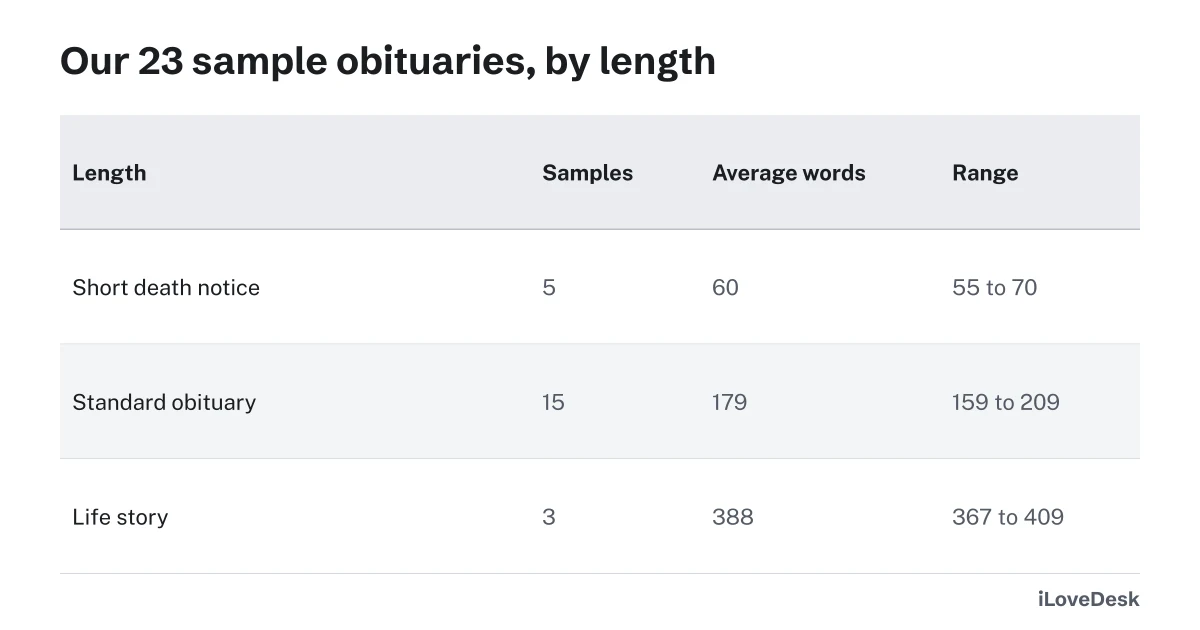
| Length | Samples | Average words | Range | Paragraphs |
|---|---|---|---|---|
| Short death notice | 5 | 60 | 55 to 70 | 3.4 |
| Standard obituary | 15 | 179 | 159 to 209 | 5.9 |
| Life story | 3 | 388 | 367 to 409 | 6 |
We wrote these made-up people to three target lengths, so the averages describe our set and are not a rule. Use them as a starting point. Ask the newspaper whether it counts words, lines or characters; the Obituary Template shows all three counts as you type.
What is the difference between an obituary and a death notice?
A death notice is a short announcement of a death, usually with the service details, and an obituary tells more of the person's life. The Library of Congress notes that the death notice is the earliest form of the obituary. In our samples the short notices run 55 to 70 words and the life stories 367 to 409.
The Library of Congress blog post Mourn Not! A History of Obituaries in American Newspapers traces how the short notice grew into the longer life story. A brief death notice in our template opens with the surname in capitals, then the age and hometown, and ends with the family and the service.
Ask the newspaper which kinds of notice it runs and what each costs. A family may place a death notice now and a longer obituary later, or only one of them.
How do you write an obituary for a mother or father?
Use the same order as for anyone else. What sets a parent's obituary apart is the detail only the family knows: the work they did, the habits the children remember, and the children and grandchildren named in the survivors line. Our standard mother and father samples run 184 and 191 words.
- Read the mother sample and the father sample to see the order written out. Each has a short and a life-story version too.
- Ask each sibling for one detail, such as a meal, a phrase or a place, and use two or three of them.
- Decide before you write who is named among the survivors, including partners, stepchildren and in-laws, so no one is left out by accident.
- Open the sample in the Obituary Template with Edit this example and replace our made-up facts with yours.
How do you submit an obituary?
Ask the funeral home first whether it will send the notice to the newspaper and post it on its own website for you. To send it yourself, ask the newspaper for its deadline, length limit and rate, paste the plain text into its form, add a photo if it accepts one, and ask to see a proof before it prints.
- Funeral home: give it the final text and photo, and ask which outlets it will use.
- Local newspaper: check the deadline for the day you want it to run, and whether it prices by word, line or column inch.
- Online memorial pages: paste the same plain text, which the template's Copy text button provides.
The Michigan Attorney General's press release on obituary pirates advises sharing the real obituary promptly, so that a copied or invented one is not mistaken for it. It also warns that copied obituary pages with a donation link may send the money somewhere else, so name the charity itself and let donors find its own page.
How do you check an obituary for mistakes?
Ask a second person who knew the family to read it against your list of facts. Check the spelling of every name, the dates, the ages, the number of grandchildren, the service time and address, and the name of any charity. Read it aloud as well, because a wrong name or number is easier to hear than to see.
- Match each name to a document or to the person who owns it, including middle names and married names.
- Confirm the service details with the funeral home, not from memory.
- Check that the age fits the two dates. The Obituary Template works the age out from them.
- Ask the newspaper how it handles corrections before you pay.
What should I leave out of an obituary to protect privacy?
Leave out the home address, and consider leaving out the full date of birth and the place of birth. The Michigan Attorney General advises families not to include the deceased person's date of birth, place of birth or address, because criminals gather details from death notices. Name the town, and give the service address instead of the home.
The Michigan Attorney General's consumer alert Identity Theft: Deceased Victims also lists steps for the family, such as ordering several copies of the death certificate. The press release linked above says details shared online can help criminals buy more personal data about the deceased person, such as an address and a Social Security number.
Our template writes whatever you type. All 23 of our 23 samples print the full birth date, because each fills the Born field. If you prefer to leave it off, leave Born empty. The dates line then reads "Died" with the date of death, the birth sentence is dropped and, because the template works the age out from the two dates, the age line goes too. You can type the age into the draft yourself.
Ready to write? Fill in the Obituary Template with your facts, or read 23 sample obituaries first.
Tools in this guide
More guides
Sources and further reading
- Library of Congress: Mourn Not! A History of Obituaries in American Newspapers: the death notice as the earliest form of the obituary
- Michigan Attorney General: Identity Theft: Deceased Victims: limit what an obituary says; leave out date of birth, place of birth and address
- Michigan Attorney General: AG Nessel Warns Residents to Beware of Obituary Pirates after Death of Loved One: obituary scams, sharing the real obituary promptly, fake donation links